 Add to Chrome
 Add to Firefox
 Add to Edge
PMC-InterCPT: Rethinking Biomedical Interleaved Data for Multimodal Continued Pretraining
May 31, 2026
Large-scale biomedical image-text datasets extracted from scientific literature provide valuable resources for medical multimodal model training. These datasets are commonly organized as image-caption pairs; however, figure captions are often short, context-dependent, and only partially informative without the surrounding article text. At the same time, large-scale automatic extraction introduces structural noise such as missing captions, residual markup, duplicated context, and incoherent multi-paragraph figure descriptions. We revisit data construction for medical multimodal continued pretraining (CPT) and present PMC-InterCPT, a context-grounded biomedical interleaved corpus that incorporates figure-referencing body text in addition to captions. Our pipeline recovers missing captions, cleans caption and context text, reconstructs coherent interleaved image-text samples, and applies LLM-supervised medical relevance and quality classifiers to filter noisy records. We further reveal strong modality imbalance in the resulting corpus and introduce a four-bucket evidence taxonomy for modality-aware resampling. Through CPT followed by supervised fine-tuning (SFT) on Qwen3.5-4B-Base, PMC-InterCPT effectively improves medical and general multimodal performance while using fewer CPT tokens than the raw source pool. The experimental results also illustrate the complementarity between the data quality and modality for medical multimodal CPT.

FeatCal: Feature Calibration for Post-Merging Models
May 13, 2026Model merging combines task experts into one model and avoids joint training, retraining, or deploying many expert models, but the merged model often still underperforms task experts. We study this performance gap through feature drift, the difference between features produced by the merged model and by the expert on the same input. Our theory decomposes this drift into upstream propagation and local mismatch, tracks how it propagates and combines through later layers in forward order, and links final feature drift to output drift. This view motivates FeatCal, which uses a small calibration set to calibrate the merged model weights layer by layer in forward order, reducing feature drift while staying close to merged weights and preserving the benefits of model merging. FeatCal uses an efficient closed-form solution to update model weights, with no gradient descent, iterative optimization, or extra modules. On the main CLIP and GLUE benchmarks, FeatCal beats Surgery and ProbSurgery, the closest post-merging calibration baselines: 85.5% vs. 77.0%/78.8% on CLIP-ViT-B/32 Task Arithmetic (TA) and 85.2% vs. 83.7%/82.2% on FLAN-T5-base GLUE. On CLIP-ViT-B/32, 8 examples per task reach 82.9%, and 256 examples per task take 53 seconds, about 4x faster than both baselines, showing better sample efficiency and lower calibration cost.
InfiR2: A Comprehensive FP8 Training Recipe for Reasoning-Enhanced Language Models
Sep 26, 2025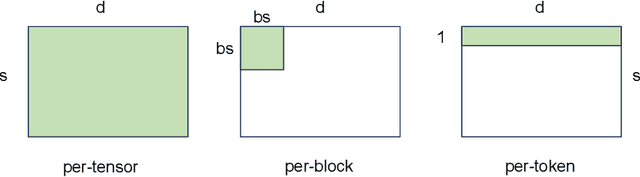
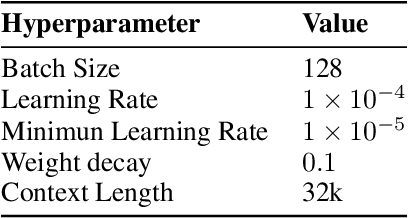
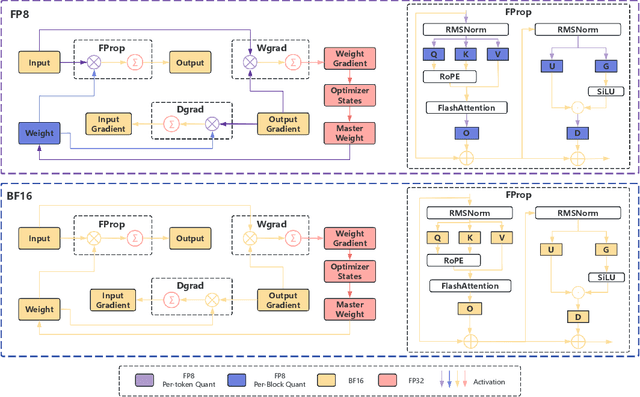
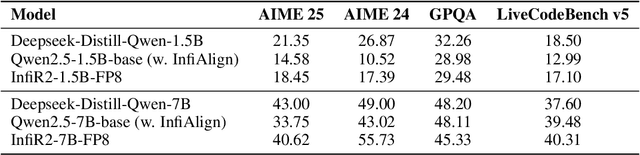
The immense computational cost of training Large Language Models (LLMs) presents a major barrier to innovation. While FP8 training offers a promising solution with significant theoretical efficiency gains, its widespread adoption has been hindered by the lack of a comprehensive, open-source training recipe. To bridge this gap, we introduce an end-to-end FP8 training recipe that seamlessly integrates continual pre-training and supervised fine-tuning. Our methodology employs a fine-grained, hybrid-granularity quantization strategy to maintain numerical fidelity while maximizing computational efficiency. Through extensive experiments, including the continue pre-training of models on a 160B-token corpus, we demonstrate that our recipe is not only remarkably stable but also essentially lossless, achieving performance on par with the BF16 baseline across a suite of reasoning benchmarks. Crucially, this is achieved with substantial efficiency improvements, including up to a 22% reduction in training time, a 14% decrease in peak memory usage, and a 19% increase in throughput. Our results establish FP8 as a practical and robust alternative to BF16, and we will release the accompanying code to further democratize large-scale model training.
InfiAlign: A Scalable and Sample-Efficient Framework for Aligning LLMs to Enhance Reasoning Capabilities
Aug 07, 2025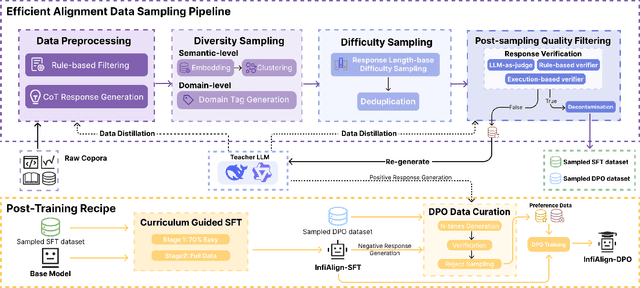
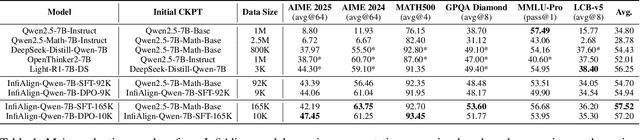
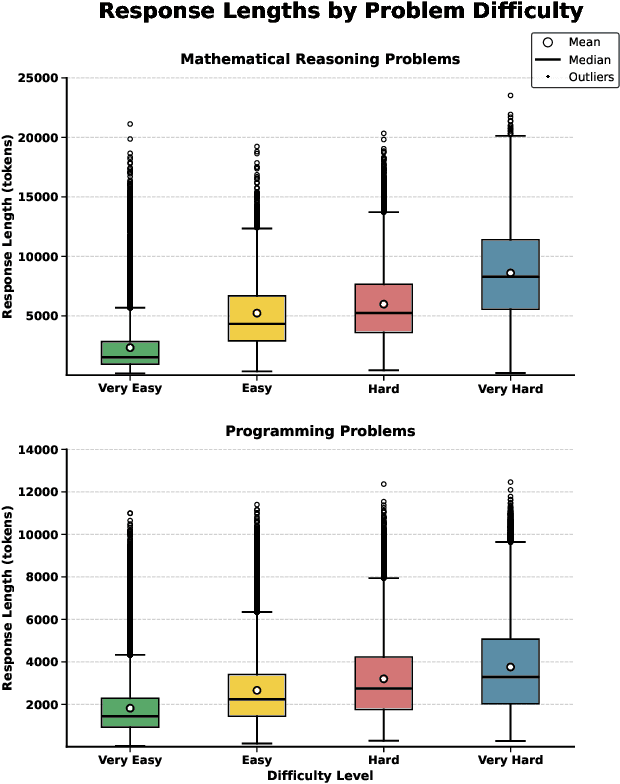
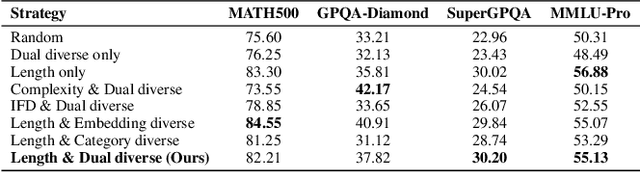
Large language models (LLMs) have exhibited impressive reasoning abilities on a wide range of complex tasks. However, enhancing these capabilities through post-training remains resource intensive, particularly in terms of data and computational cost. Although recent efforts have sought to improve sample efficiency through selective data curation, existing methods often rely on heuristic or task-specific strategies that hinder scalability. In this work, we introduce InfiAlign, a scalable and sample-efficient post-training framework that integrates supervised fine-tuning (SFT) with Direct Preference Optimization (DPO) to align LLMs for enhanced reasoning. At the core of InfiAlign is a robust data selection pipeline that automatically curates high-quality alignment data from open-source reasoning datasets using multidimensional quality metrics. This pipeline enables significant performance gains while drastically reducing data requirements and remains extensible to new data sources. When applied to the Qwen2.5-Math-7B-Base model, our SFT model achieves performance on par with DeepSeek-R1-Distill-Qwen-7B, while using only approximately 12% of the training data, and demonstrates strong generalization across diverse reasoning tasks. Additional improvements are obtained through the application of DPO, with particularly notable gains in mathematical reasoning tasks. The model achieves an average improvement of 3.89% on AIME 24/25 benchmarks. Our results highlight the effectiveness of combining principled data selection with full-stage post-training, offering a practical solution for aligning large reasoning models in a scalable and data-efficient manner. The model checkpoints are available at https://huggingface.co/InfiX-ai/InfiAlign-Qwen-7B-SFT.
InfiR : Crafting Effective Small Language Models and Multimodal Small Language Models in Reasoning
Feb 17, 2025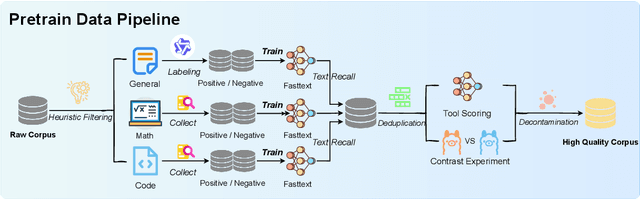

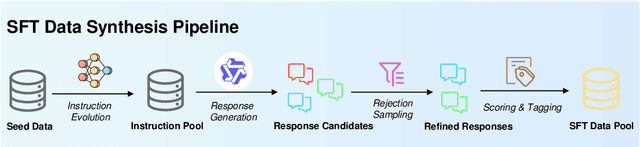

Large Language Models (LLMs) and Multimodal Large Language Models (MLLMs) have made significant advancements in reasoning capabilities. However, they still face challenges such as high computational demands and privacy concerns. This paper focuses on developing efficient Small Language Models (SLMs) and Multimodal Small Language Models (MSLMs) that retain competitive reasoning abilities. We introduce a novel training pipeline that enhances reasoning capabilities and facilitates deployment on edge devices, achieving state-of-the-art performance while minimizing development costs. \InfR~ aims to advance AI systems by improving reasoning, reducing adoption barriers, and addressing privacy concerns through smaller model sizes. Resources are available at https://github. com/Reallm-Labs/InfiR.
Divide-and-Conquer: Tree-structured Strategy with Answer Distribution Estimator for Goal-Oriented Visual Dialogue
Feb 09, 2025Goal-oriented visual dialogue involves multi-round interaction between artificial agents, which has been of remarkable attention due to its wide applications. Given a visual scene, this task occurs when a Questioner asks an action-oriented question and an Answerer responds with the intent of letting the Questioner know the correct action to take. The quality of questions affects the accuracy and efficiency of the target search progress. However, existing methods lack a clear strategy to guide the generation of questions, resulting in the randomness in the search process and inconvergent results. We propose a Tree-Structured Strategy with Answer Distribution Estimator (TSADE) which guides the question generation by excluding half of the current candidate objects in each round. The above process is implemented by maximizing a binary reward inspired by the ``divide-and-conquer'' paradigm. We further design a candidate-minimization reward which encourages the model to narrow down the scope of candidate objects toward the end of the dialogue. We experimentally demonstrate that our method can enable the agents to achieve high task-oriented accuracy with fewer repeating questions and rounds compared to traditional ergodic question generation approaches. Qualitative results further show that TSADE facilitates agents to generate higher-quality questions.
Adversarial Driving Behavior Generation Incorporating Human Risk Cognition for Autonomous Vehicle Evaluation
Oct 14, 2023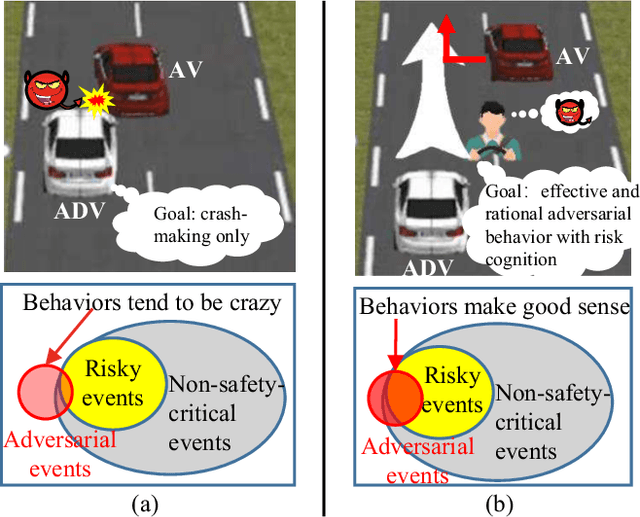
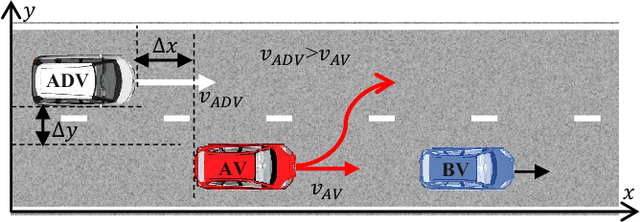


Autonomous vehicle (AV) evaluation has been the subject of increased interest in recent years both in industry and in academia. This paper focuses on the development of a novel framework for generating adversarial driving behavior of background vehicle interfering against the AV to expose effective and rational risky events. Specifically, the adversarial behavior is learned by a reinforcement learning (RL) approach incorporated with the cumulative prospect theory (CPT) which allows representation of human risk cognition. Then, the extended version of deep deterministic policy gradient (DDPG) technique is proposed for training the adversarial policy while ensuring training stability as the CPT action-value function is leveraged. A comparative case study regarding the cut-in scenario is conducted on a high fidelity Hardware-in-the-Loop (HiL) platform and the results demonstrate the adversarial effectiveness to infer the weakness of the tested AV.